3. What may be composed
Here is the sentence from step 1 with its consequence attached:
register_stage puts a class in a process-global registry, so every stage
this process imports is a stage every pipeline in it can name.
That is fine while the pipelines are yours. It stops being fine the moment
they are not — and "the developer defines the blocks, someone less trusted
composes them" is the arrangement StageFlow exists for. Without something
else, ChargeCardStage is available to any JSON anybody posts.
The something else is a Policy: given by the host, never
readable from the pipeline, and never wideneable by it.
from stageflow import Limits, Policy

BASIC = Policy(
    stages={"LoadTicketStage", "ClassifyByRulesStage", "SearchKnowledgeStage",
            "RenderReplyStage", "SendReplyStage", "EscalateStage",
            "SetValueStage", "ConcatStage", "TemplateStage"},
    node_types={"entry", "stage", "condition", "switch", "terminal"},
    limits=Limits(
        counters={"seconds": 15, "steps": 200, "kb_lookups": 20, "replies_sent": 1},
        gauges={"concurrency": 2, "depth": 2, "frame_bytes": 200_000},
        max_retries=2, max_delay_seconds=2,
    ),
)
Three things, and None in any of them means "no opinion", which is not the
same as an empty set: Policy() allows everything, Policy(stages=set())
allows no stage at all.
Two layers, the same answer
pipeline.validate(policy)                       # before: the whole graph, at once
Session(id=..., pipeline=..., policy=policy)    # during: every node, as it is reached
Validation is what a person acts on — it names every problem in one go, so a graph can be fixed rather than discovered to be wrong one node at a time. The runtime check is what actually holds, because a graph can reach a session without ever being validated. Neither replaces the other, and the wording is the same either way.
The example validates in the request handler, before a thread is even started:
def start(self, payload: dict, policy: Policy) -> Run:
    pipeline = Pipeline.from_dict(payload.get("pipeline") or {})
    pipeline.validate(policy)      # a refusal answers the POST, not a thread minutes later
    ...
    session = Session(..., policy=policy)
Telling the editor, so it can tell the author
A policy the editor does not know about is a policy the author discovers by being refused. So both read-only endpoints are narrowed by it:
@router.get("/stages")
async def stages(caller: CallerPlan) -> dict:
    policy = policy_for(caller)
    return {"stages": {name: cls.get_specs()
                       for name, cls in get_stages().items()
                       if policy.allows_stage(name)}}


@router.get("/meta")
async def meta(caller: CallerPlan) -> dict:
    policy = policy_for(caller)
    return {"api": 1, "plan": caller, **capabilities(policy), "limits": _limits_of(policy)}
Sending the specs of a stage the policy forbids would have the editor draw it
in the palette and the run refuse it — exactly the mismatch the policy exists
to remove, reintroduced one endpoint later. capabilities(policy) does the
same for node types.
What that buys, on the cheap plan of the example, looking at a pipeline that
needs a map:
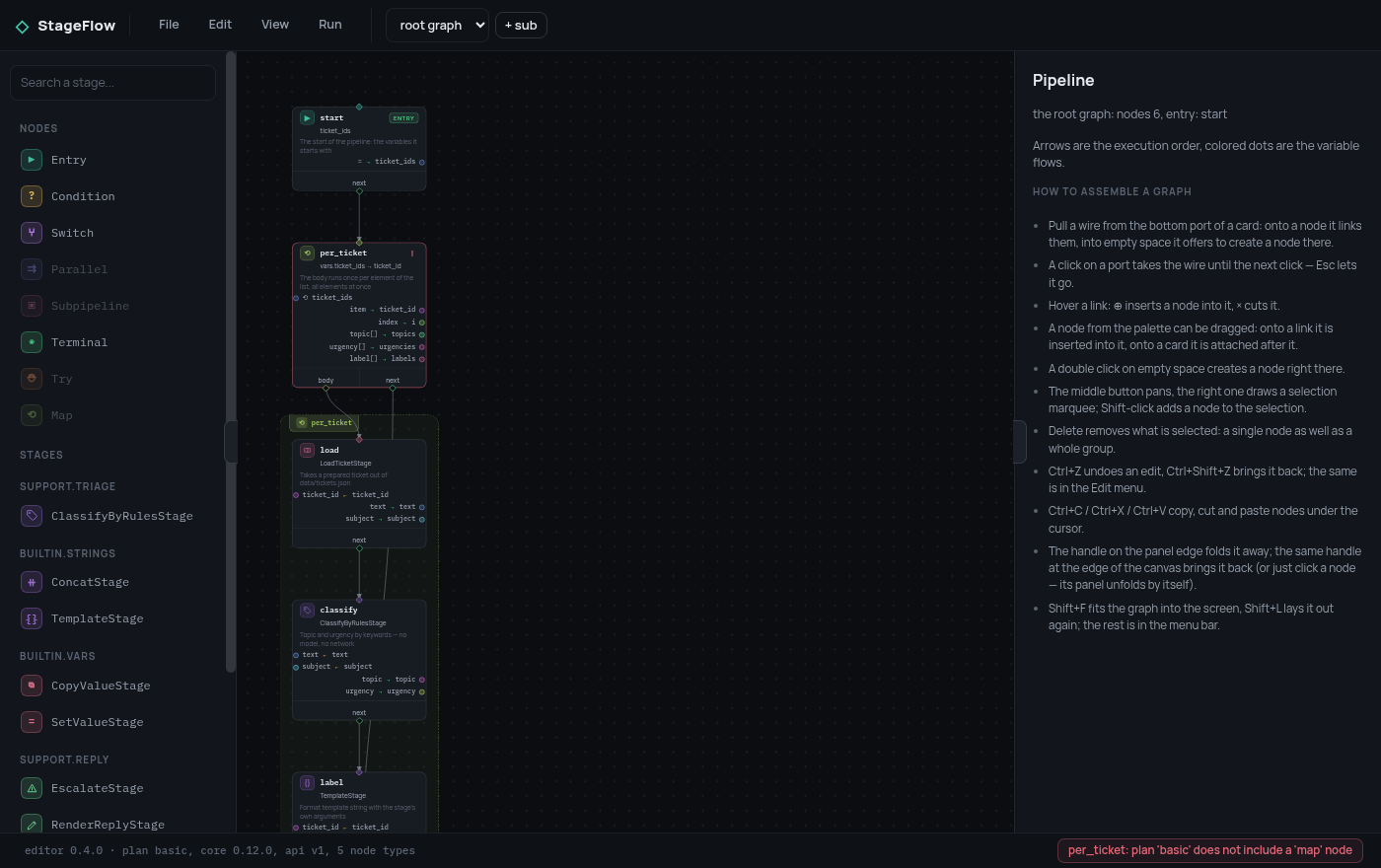
Four node types are dim in the palette, the offending node carries a marker,
and the status bar reads per_ticket: plan 'basic' does not include a 'map'
node — before anybody presses Run.
What validation checks, and what it refuses to guess
Against limits, static validation checks only what is soundly knowable
from the JSON:
| Checked | Why it is honest |
|---|---|
the shortest path through the graph against steps |
every run passes at least that many nodes, so a graph whose cheapest path does not fit cannot finish at all |
the nesting depth of declared subpipelines against depth |
the nesting is written down, not computed |
what each retry asks for against max_retries and max_delay_seconds |
the numbers are in the JSON |
A loop's cost is not on that list and never will be: the number of passes comes from the data and the cost of a pass from its arguments. Any multiplication there would refuse graphs that fit, and a false refusal of a working graph is worse than the ceiling it was protecting.
The ceiling is hard
BudgetExceeded inherits from BaseException, deliberately outside the
StageFlowError hierarchy: try blocks catch Exception and so does the
retry machinery, and a tenant who can wrap a graph in a try and swallow the
refusal would turn every limit into decoration. Exactly one place catches it —
Session.run — and ends the run the way stop does:
result.result   # {"status": "budget_exceeded", "meter": "kb_lookups", "limit": 20, "spent": 21}
result.meters   # everything spent — this is what an invoice is built from
Next: what a run costs — filling those meters in.