The subpipeline node
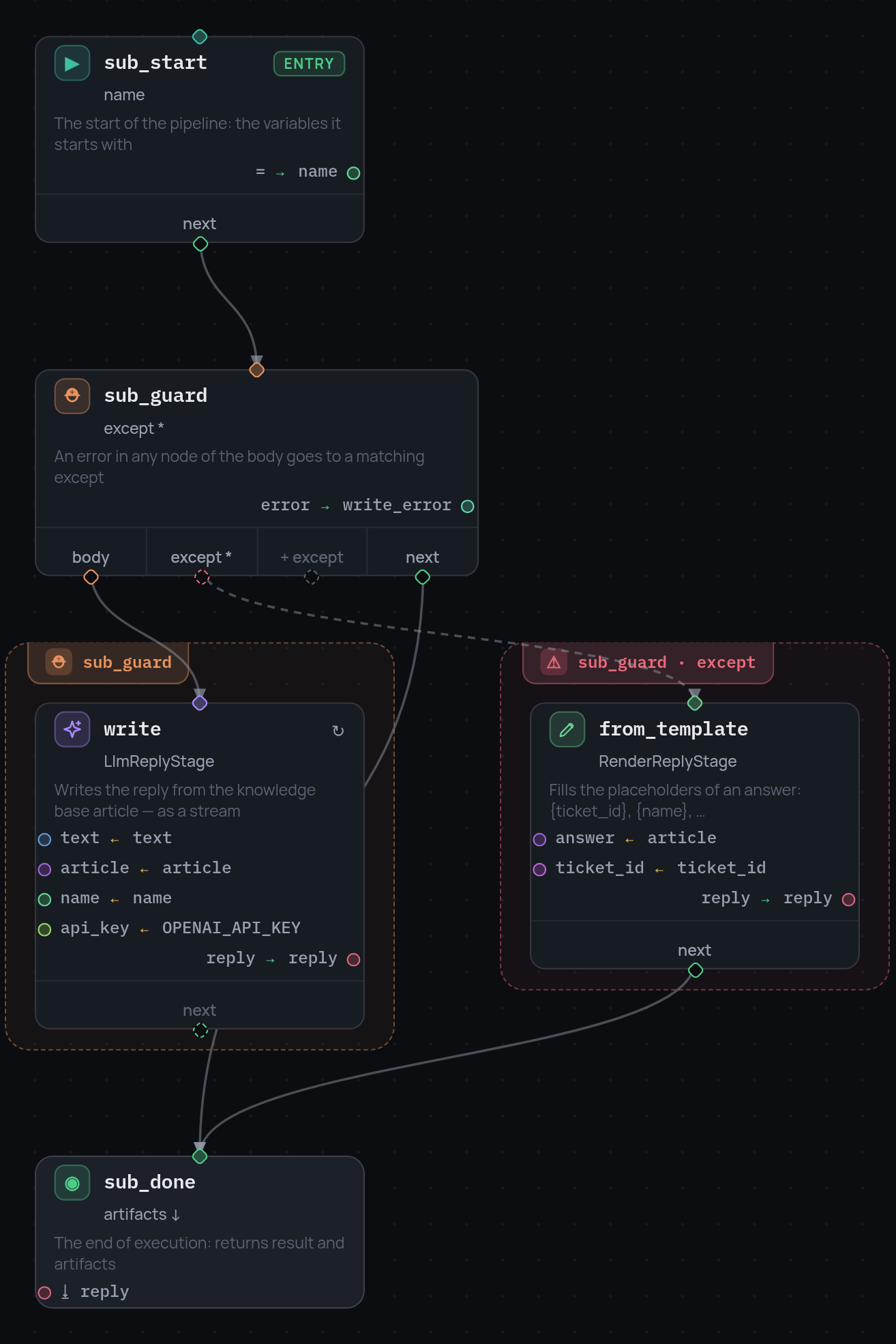
A whole graph behind one card. The child runs in its own session with a fresh frame: nothing crosses the boundary that was not named.
{
  "id": "write_reply",
  "type": "subpipeline",
  "subpipeline_id": "reply",
  "inputs": { "topic": "topic", "text": "ticket_text" },
  "artifact_outputs": { "reply": "answer" },
  "result_output": "reply_status",
  "next": "send"
}
The child graph is declared in the header of the pipeline, next to nodes:
{
  "entry": "start",
  "nodes": [ … ],
  "subpipelines": {
    "reply": {
      "entry": "compose",
      "nodes": [
        { "id": "compose", "type": "stage", "stage": "TemplateStage",
          "arguments": { "const": { "template": "About {topic}: we are on it" },
                         "vars": { "topic": "topic" } },
          "outputs": { "value": "answer" }, "next": "done" },
        { "id": "done", "type": "terminal",
          "result": { "status": "written" }, "artifacts": ["answer"] }
      ]
    }
  }
}
What crosses the boundary
| Field | Direction | Reads as |
|---|---|---|
inputs |
in | { "name inside the child": "variable of the parent" } |
artifact_outputs |
out | { "variable of the parent": "artifact of the child" } |
result_output |
out | one variable ← the result of the child's terminal |
Note that the two directions are written the other way round from each other:
in both cases the child's name is the one next to the word child in the
table — inputs is keyed by it, artifact_outputs is valued by it. The rule
behind it is that the parent's variable is always on the side the value moves
towards.
Everything else stays where it is. The child cannot see the parent's frame, and a write inside the child is invisible outside unless its terminal exports it as an artifact.
The rest of the contract
- An artifact asked for and not returned is an
ArtifactNotFoundErrornaming what the child did return — like a missing stage output, it fails at the cause. - Type declarations of the parent are inherited by a
child that declares none of its own, so
ticket_idmeans the same thing on both sides. Thesubpipelinesmap is passed down as well: a child may use a subpipeline node itself. - The child's events reach the parent's stream, each tagged with
subpipeline_node: "<id>", and the session id isparent:node— a nested run is readable in the log without being confused with the outer one. - The debugger is inherited too: stepping walks into the child node by node, it is not one opaque jump.
- So are the policy and the budget, and they have to be: a child with its own allowance would be a way out of both. The child graph is validated against the policy when its session is built, and the meters it moves are the parent's.
retryon the node repeats the whole child run.- The id must be a key of
subpipelines, and it may not be the id of the root entry node — validation says so before the run.
Recursion is not guarded
Because the child inherits the same subpipelines map, a subpipeline that
references itself will keep opening child sessions until the process runs
out of stack. There is no depth limit in the core: a recursive graph needs
its own stopping condition — a condition on a depth variable passed
through inputs.