The try node
Error handling is block-scoped: a try node covers a region of the graph, and
an error raised by any node inside it goes to the matching except.
{
  "id": "safe_fetch",
  "type": "try",
  "body": "fetch",
  "except": [
    { "error_equals": ["TimeoutError"], "next": "on_timeout", "result_var": "error" },
    { "error_equals": ["*"], "next": "on_any" }
  ],
  "next": "after"
}
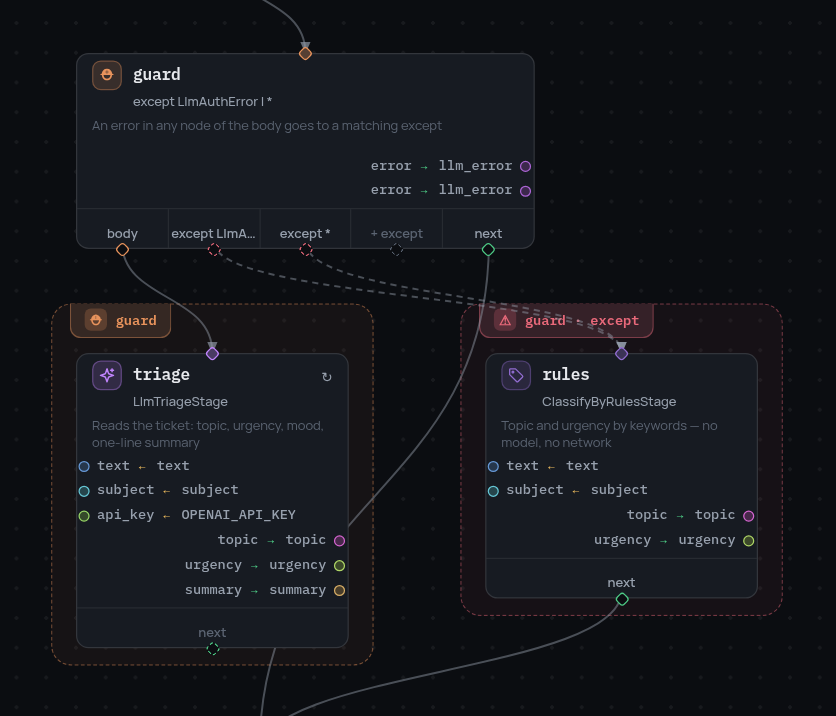
The region is derived, not listed
The block covers every node reachable from body but not reachable from
next — the same rule the map loop uses for its body. So the
block is defined by the shape of the graph: move an edge and the protected
region changes with it, and there is no list of members to keep in sync.
Nested blocks work as expected: an inner try simply lies inside the outer
one's region.
Choosing a handler
error_equalsaccepts a bare exception class name (TimeoutError), a fully qualified path (stageflow.exceptions.BranchError), or*.- Handlers are tried in order and the first match wins, so the specific ones
go above
*. - An error no handler matches keeps propagating outwards, to the nearest enclosing block or out of the session.
result_varputs the error into the frame as an object with the fieldstype,full_type,messageandnode— the last one names the node that failed, which is not the block itself. A failure deeper than one scope is named by the node of this block's body that contained it: an error from inside a nestedtryor amapbody names that nested node, because that is the node this handler's own graph has.
A handler sees the frame as the last successfully completed node of the body left it: the writes made before the failure are there, the failing node's are not.
Where a road inside the block leads
A road that simply ends ("next": null) hands control back to the block,
which continues at its own next. That is true of the body and of a handler
alike — a handler is a part of the block, not an exit from it.
A road may also leave the block outright, by pointing at a node the block does
not own; the block then stops owning that road. (This is the one place where
try and map differ: a loop refuses such a road, because
leaving mid-iteration would abandon the elements still to come.)
A terminal inside the block ends the whole run, and
nothing after the block is executed.
Order of recovery
The failing node's own retry policies are exhausted first, and
only then does the error propagate to the nearest enclosing try. Retrying is
a property of an operation; catching is a property of a region — they compose
rather than compete.