Variable typing
Typing is gradual: an undeclared variable is not checked, and the type sections are optional.
{
  "types": {
    "UserId": "int",
    "User": {
      "id": "UserId",
      "name": "string",
      "email?": "string",
      "settings": { "theme": "string" }
    },
    "Point": { "fields": { "x": "int", "y": "int" }, "strict": true },
    "Tree":  { "value": "int", "children": "list<Tree>" }
  },
  "variables": { "user": "User", "attempts": "int", "tags": "list<string>" }
}
The type language: primitives string, int, float, number (int|float),
bool, any, null; containers list<T> and map<T> (string keys); unions
T|U; the shorthand T? for T|null; names from the types section.
Structures support optional fields (a ? suffix on the name), nested
anonymous structures, recursion, and a strict mode (strict forbids extra
fields).
Checks come in two layers:
- statically, during graph validation: a variable's declared type is matched
against the type hints in the stage specification, and
exposerequires the source and destination to be compatible; a mismatch is aPipeline.validate()error raised before the run starts; - dynamically, during execution: every write to a declared variable (
entry,outputs,expose,except.result_var, subpipeline artifacts) and the session's input context are checked against the full structure of the value; a mismatch raisesTypeCheckErrorcarrying the node and the path to it.
A subpipeline inherits its parent's named types and may declare its own; variable types are its own.
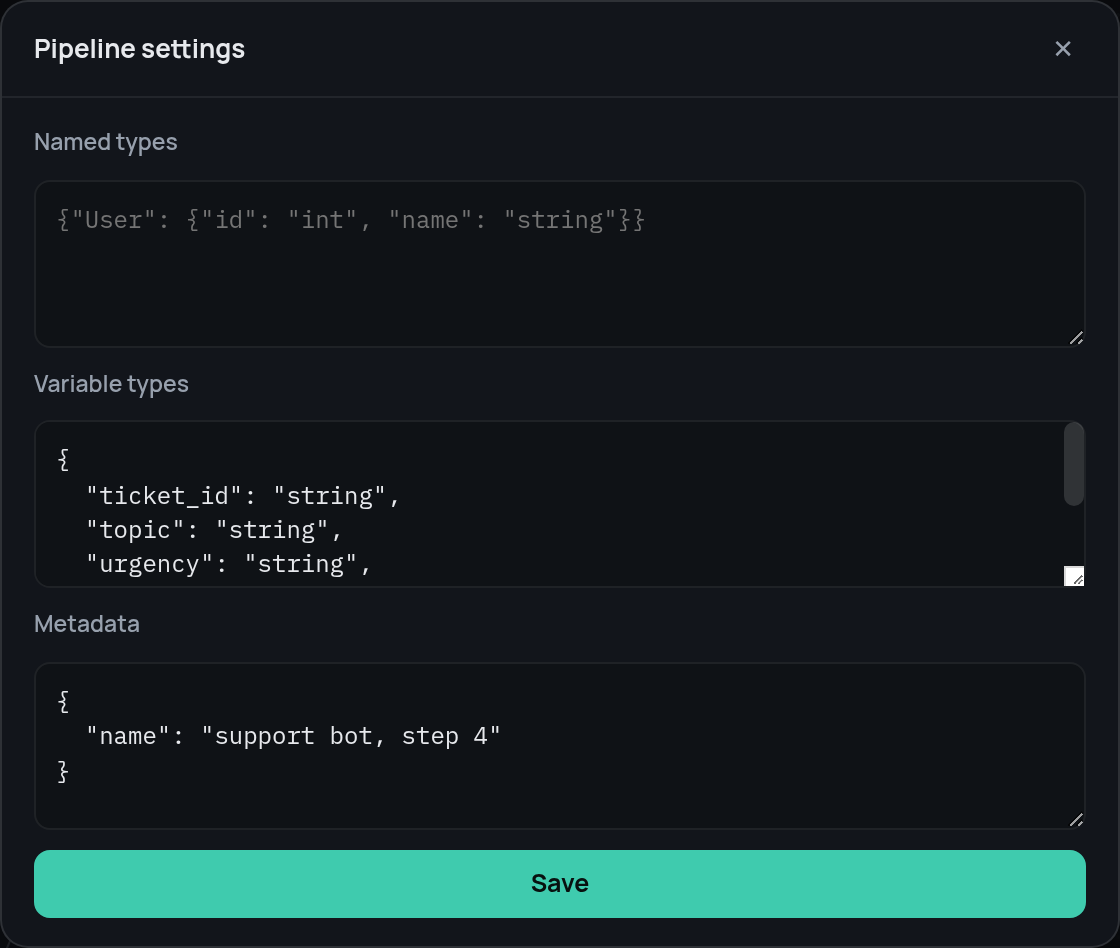
Both sections are editable in the editor, under "File" → "Pipeline settings…":