Step debugging
Session accepts a debugger that is given control before and after every
node. The in-core implementation is StepDebugger.
from stageflow import Pipeline, Session, StepDebugger

debugger = StepDebugger(mode="step", delay=0.0, on_event=print)
session = Session("s1", Pipeline.from_dict(data), debugger=debugger)
task = asyncio.create_task(session.run())   # stops before the first node

debugger.step()                  # let one node run, then stop again
debugger.set_vars({"n": 42})     # applied before the next node
debugger.set_delay(0.5)          # run on its own, pausing between nodes
debugger.resume()                # continue without stopping
result = await task
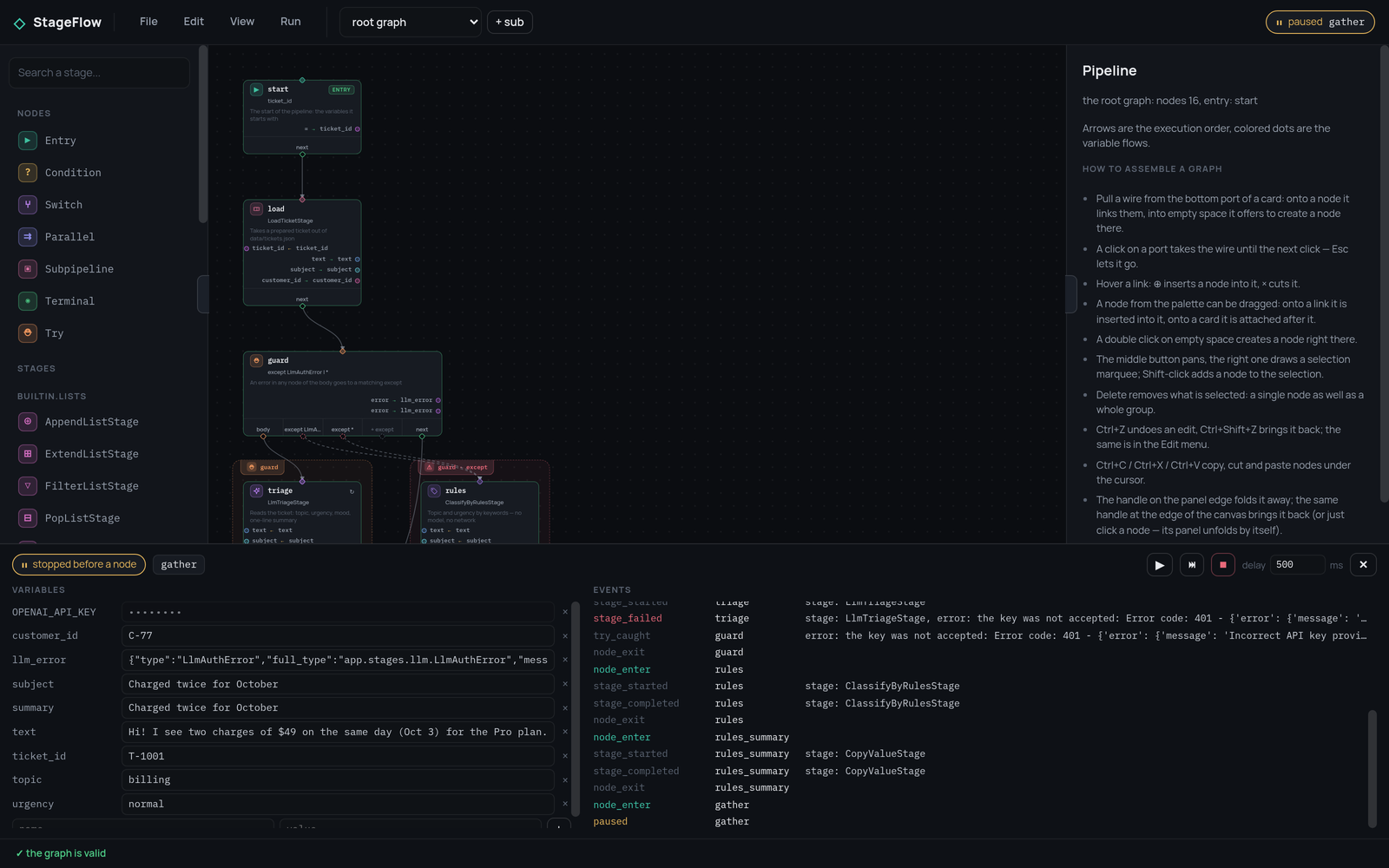
Available from outside: the stop point (debugger.node), the frame at that
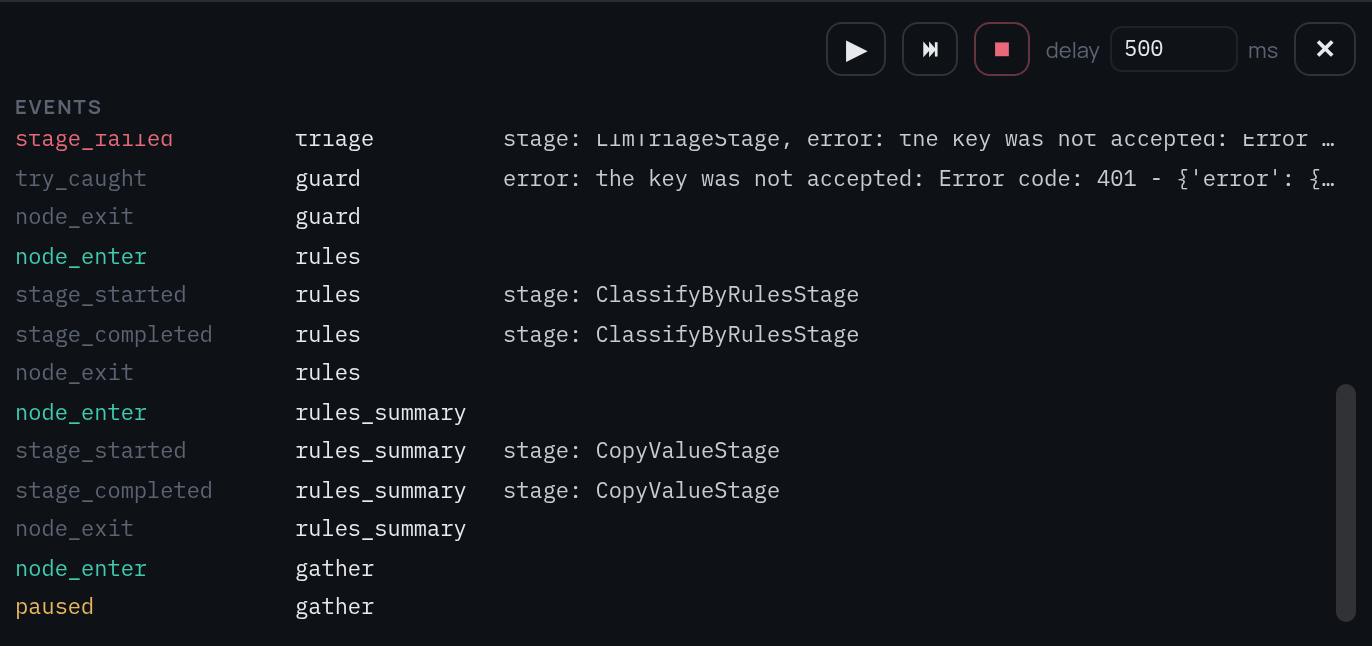
point (debugger.vars), and the on_event stream: node_enter, node_exit,
paused, var_set, var_rejected. Frame edits are checked against declared
types — a mismatch is rejected with an event rather than crashing the session.
The debugger also applies inside a try body, inside parallel branches and
inside a subpipeline: every node goes through Session.execute_node, and a
child session inherits the debugger. Commands are thread-safe.
The editor is a front end for exactly this: it stops between nodes, shows the frame on the left and the event stream on the right.