Data model
Pipeline data is a single frame, vars, carried along the execution path.
The frame is immutable: every write produces a new one, so parallel branches
diverge independently and the same object can safely be handed to several
concurrent consumers. The only visibility boundary is subpipeline: a child
starts with a fresh frame and receives data through inputs.
A node's arguments are split into buckets: vars holds references to frame
variables, const holds literals. Buckets can be mixed in one node; on a name
collision the variable reference wins over the literal. A stage node has no
separate settings field — a literal setting is a const argument.
{
  "id": "auth",
  "type": "stage",
  "stage": "AuthStage",
  "arguments": { "vars": { "creds": "creds" }, "const": { "timeout_s": 30 } },
  "outputs":   { "token": "token" },
  "consume": ["creds"],
  "next": "fetch"
}
In outputs the key is the name of a field in the stage result and the value
is the variable to store it in. A field the stage does not return is rejected
by Pipeline.validate() against the stage specification. If a stage declares
no outputs at all, the contract is considered undeclared and the check is
skipped.
A node's outputs are applied as a simultaneous assignment: values are computed against the frame as it was on entry and only then written, so key order does not affect the result.
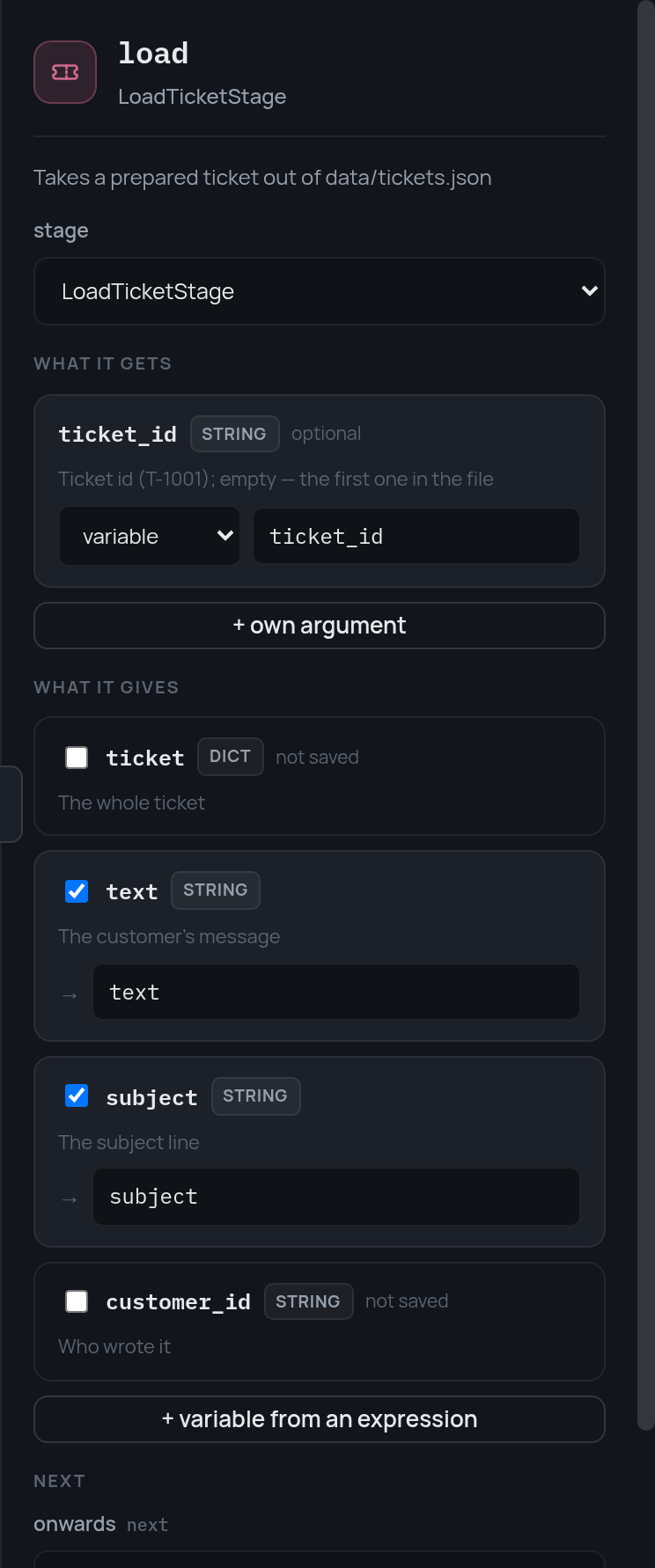
On a card this is the two halves: above the divider what the node reads, below it what it writes.
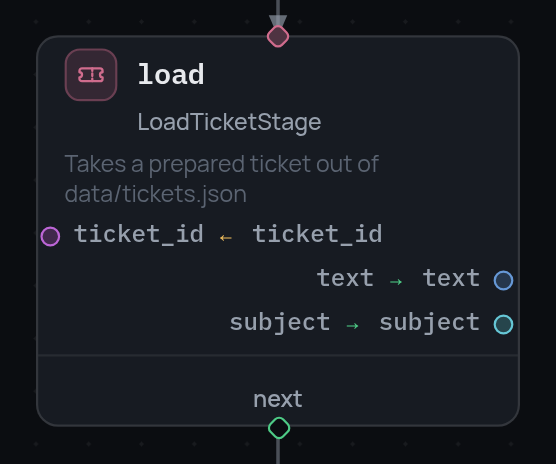
The panel on the right is the same node as a form, built from the stage specification: