The map node
{
  "id": "per_ticket",
  "type": "map",
  "items": "vars.tickets",
  "body": "classify",
  "item_var": "ticket",
  "index_var": "i",
  "collect": { "reply": "replies" },
  "mode": "sequential",
  "next": "send_all"
}
map runs one region of the graph once per element of a list. The region is
the body, derived exactly like the body of a try block:
everything reachable from body but not from next. The editor frames it and
shows on the card what goes in and what comes out:
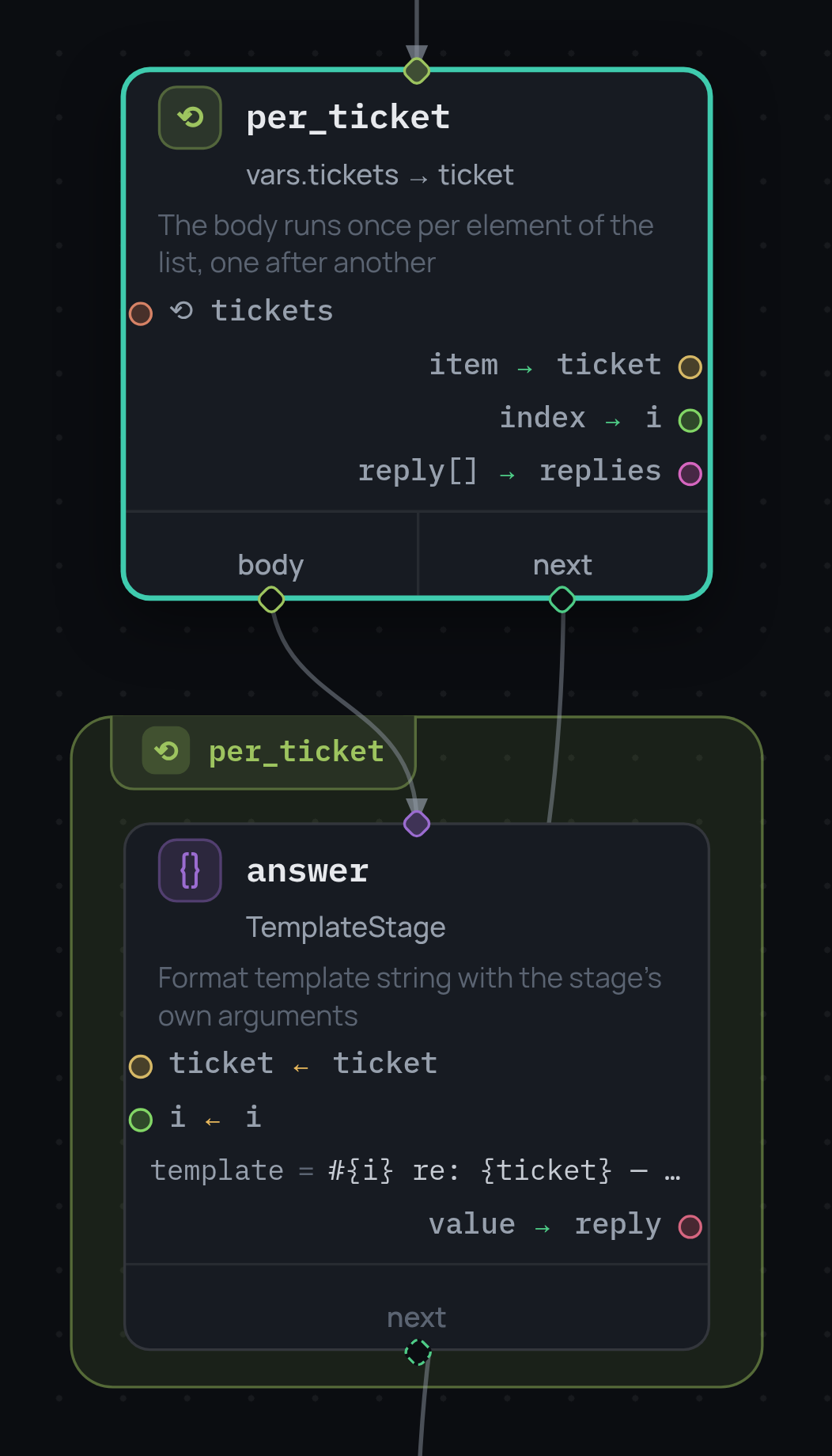
What an iteration sees
Every iteration starts from its own copy of the frame as it was when the loop
began, with the element bound to item_var (default item) and, if asked
for, the zero-based position bound to index_var. Iterations therefore never
see each other's writes — the same rule as the branches of a
parallel node, and the reason the two modes behave
alike.
What leaves
Only collect. A name written inside the body becomes a list outside, one
entry per element, in the order of the items — not the order in which the
iterations finished, which matters in parallel mode:
reads vars.reply at the end of every iteration and leaves
vars.replies == [reply₀, reply₁, …] behind. A list is shorthand for keeping
the name: "collect": ["reply"]. An iteration that never writes the name
fails the node with StageOutputError — a hole in the middle of a collected
list is never what was meant. An empty items list collects an empty list and
goes straight to next.
Declared types are checked on the way out: if replies is declared, the
collected list is checked against it before it enters the frame.
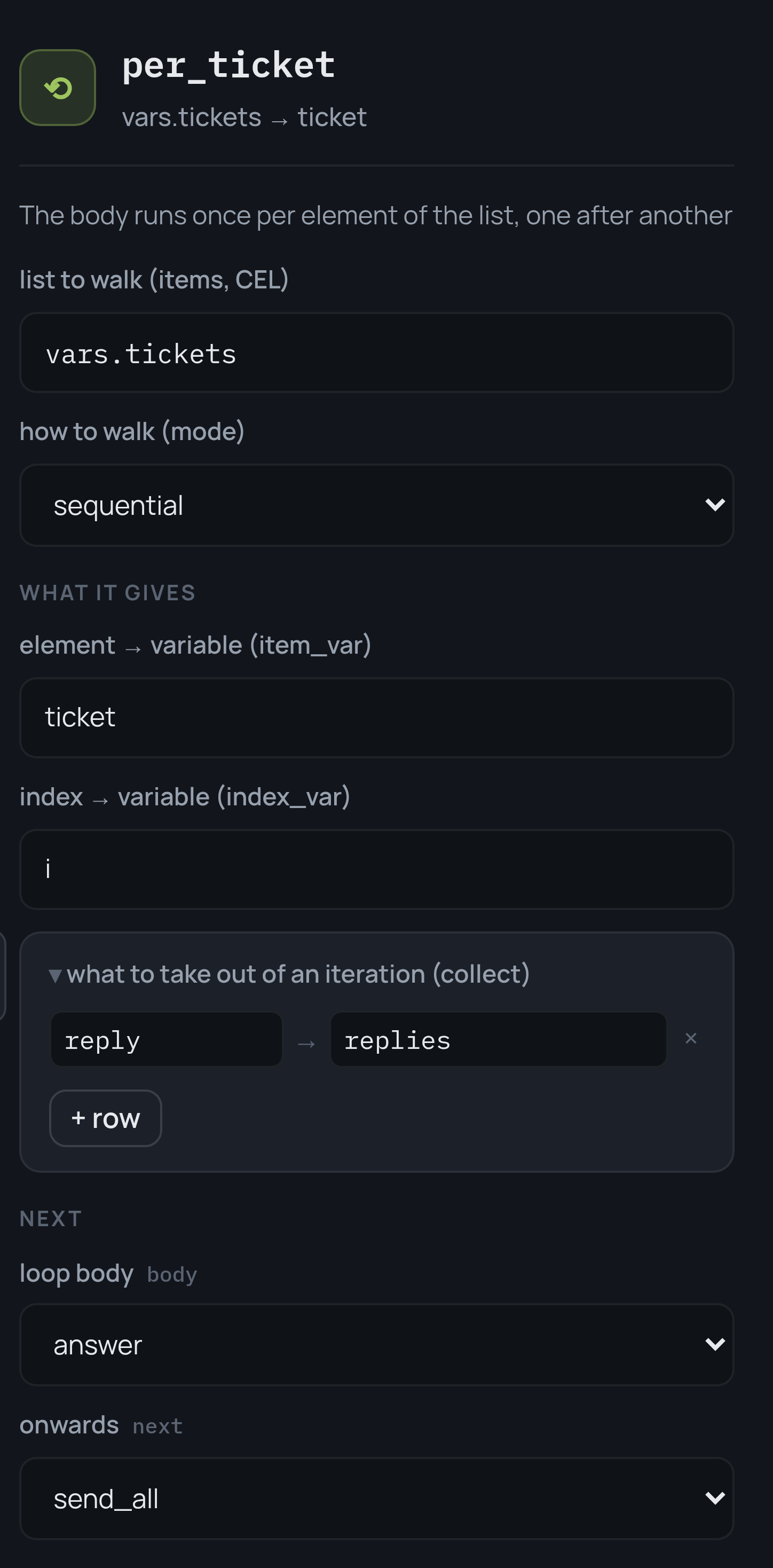
The panel is the same JSON in words — the list, the pace, the names the element and the index arrive under, and the table of what to collect:
Sequential and parallel
mode is sequential (default) or parallel. cancel_on_error (default
true) decides what happens to the remaining elements when one fails: true
stops at the first failure — in parallel mode cancelling the iterations still
running, with a map_cancelled event — and false lets every element run
before the node fails with the error of the earliest failed element.
The error is raised unchanged, not wrapped: a try block around a map
matching on ValueError catches the ValueError the body raised. The index is
in the map_item_failed event.
retry on the map node itself repeats the whole loop, not the element that
failed — it is a property of the node, as everywhere else.
How many passes a loop may make is not something the graph can settle: the
count comes from the data. It is a meter instead — iterations
is charged before the first pass, so a loop wider than the host allows is
refused having run none of it.
The body must be closed
Every road inside the body has to end inside it. A road out of the region is a validation error:
per_ticket: 'classify' leads to 'send_all', outside the loop body;
a road inside the body must end inside it
A try block tolerates a road out — it simply stops owning it. A loop cannot:
leaving in the middle of the third element would abandon the elements still to
come, and in parallel mode there would be no single frame to continue with. A
terminal inside the body is still allowed and ends the whole run, as it does
everywhere.
Events
| Event | Payload |
|---|---|
map_started |
items, mode, body |
map_item_started, map_item_completed |
index |
map_item_failed |
index, error, type |
map_cancelled |
items — the indices cancelled |
map_completed |
items, collected |