The stage node
The only node that does work. Everything else decides where to go; a stage
runs a registered stage class and writes what it returned into the frame.
{
  "id": "greet",
  "type": "stage",
  "stage": "TemplateStage",
  "arguments": {
    "const": { "template": "Hello, {name}! You have {count} tickets." },
    "vars": { "name": "user", "count": "open_tickets" }
  },
  "outputs": { "value": "greeting" },
  "consume": ["user"],
  "next": "done"
}
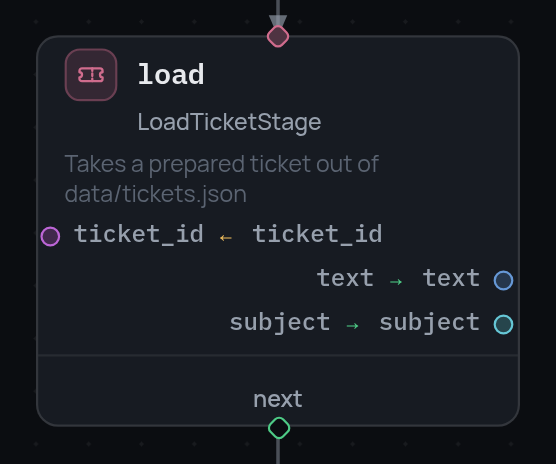
Arguments: two buckets
A stage never reaches into the frame itself — it only receives arguments. Both buckets end up as one flat set of keyword arguments:
| Bucket | Means | Example |
|---|---|---|
const |
a literal, written in the pipeline | "template": "Hello, {name}!" |
vars |
the value of a frame variable | "name": "user" → the argument name gets vars.user |
vars also accepts a list when the argument and the variable share a name:
"vars": ["ticket_id"] is the same as "vars": {"ticket_id": "ticket_id"}.
A key ending in .$ is a CEL expression instead of a value,
and works in either bucket:
"arguments": {
  "const": { "greeting.$": "'Hello, ' + vars.user" },
  "vars": { "total.$": "vars.a + vars.b" }
}
The argument is named without the suffix (greeting, total). Which bucket
holds the expression makes no difference — the suffix is what decides.
Outputs: what goes back into the frame
What the stage returned becomes a namespace of fields:
| The stage returned | The namespace |
|---|---|
| a dict | itself |
| an object | its attributes (vars(obj)) |
| anything else | {"value": …} |
None |
empty |
outputs maps a field of that namespace to a variable — field first,
variable second:
Nothing is written implicitly: a field the stage returned and outputs does
not mention simply stays behind. A field that outputs asks for and the stage
did not return is a StageOutputError naming what was available — fail-fast
at the cause, rather than a KeyError three nodes later.
A computed output is the mirror image of a computed argument — the key carries
the .$ and the destination, the value is the expression, and the stage's
return is visible in it as output:
consume: dropping what is no longer needed
The names are removed from the frame after the step. Useful for a bulky value that only mattered to this stage — a downloaded page, a decoded file — so that it is not dragged along the rest of the graph and does not show up in the snapshot of a session.
What validation catches before the run
Pipeline.validate() compares the node against the
spec of the stage:
- an unknown stage name;
- an output field the stage does not declare (
does not return field 'x'
  (available: [...])
) — unless the spec declares*; - with typing on, an argument fed by a variable whose declared type does not match the spec, and an output written into a variable of the wrong type.
retry and expose work here as on any node — see
Errors and Node types.